Fasteners
Bolts, nuts, screws, washers and anchors across the full commercial grade range, supplied to DIN, ISO and ANSI dimensional standards with mechanical property certification.
At a glance
- Property classes 4.6 through 12.9 and stainless A2 and A4
- DIN, ISO and ANSI or ASME dimensional standards
- Zinc, hot-dip galvanised, black oxide and zinc-flake finishes
- Mechanical and chemical test certificates per lot
- Consolidated mixed-item container loads
Fasteners are a specification purchase
Fasteners look like a commodity and are not. A bolt is defined by its dimensional standard, its property class, its material, its thread form and tolerance, its surface treatment and its coating thickness, and two bolts that appear identical can differ by a factor of three in tensile strength. Buying fasteners on price and appearance is how understrength product ends up in a structure, and it is why VP Global Exim treats fastener supply as a documented specification exercise with certification per lot rather than as a trading transaction.
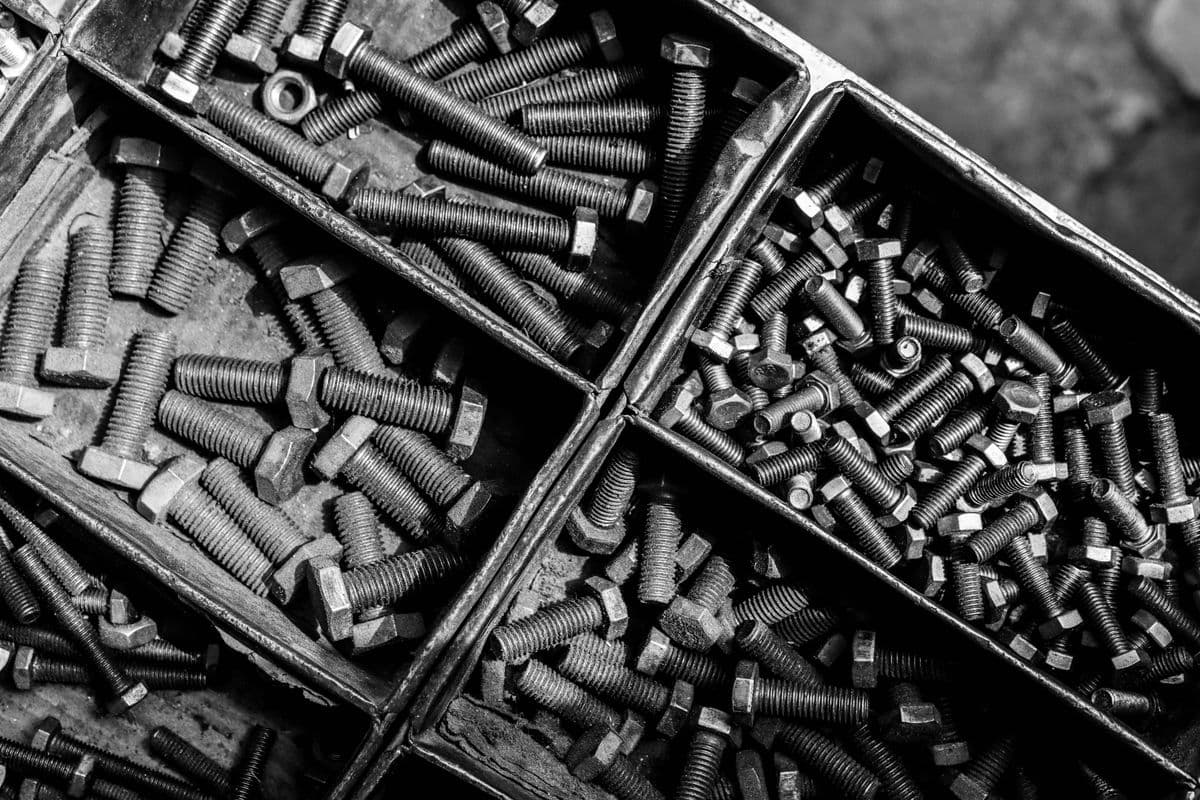
We export the full commercial range from India's fastener manufacturing base: hexagon head bolts and set screws, hexagon nuts in standard, thin and high forms, socket head cap screws and grub screws, carriage, coach and structural bolts, studs and threaded rod, machine and self-tapping screws, self-drilling screws, wood and chipboard screws, drywall screws, roofing screws with bonded washers, flat, spring, tooth and sealing washers, and anchors including through bolts, sleeve anchors, wedge anchors, drop-in anchors, chemical anchor studs and plastic plugs.
The buyers we serve are typically hardware distributors and wholesalers, construction contractors and project buyers, industrial maintenance and MRO buyers, manufacturers using fasteners in assembly, and retail and trade-counter operators requiring packaged product. Each needs a different balance of grade, packaging and documentation, and the specification is set accordingly rather than from a single default.
Grades, property classes and materials
Carbon and alloy steel fasteners are supplied by property class, which defines minimum tensile strength and yield in a coded form. Class 4.6 and 4.8 cover general non-structural use. Class 8.8 is the mainstream engineering and structural grade and covers the majority of demand. Classes 10.9 and 12.9 are high-strength grades used in machinery, structural connections and applications with high preload, and they require heat treatment and careful control of hydrogen embrittlement risk during plating.
Nuts are supplied in matched property classes so the assembly fails predictably. A high-strength bolt used with an understrength nut produces a joint that strips the nut thread rather than developing the bolt's capacity, which is a failure mode that testing the bolt alone will never reveal. We supply matched bolt and nut classes as a matter of course and will point it out when an enquiry specifies a bolt grade and leaves the nut unspecified.
Stainless steel fasteners are supplied in austenitic grades, commonly designated A2 corresponding to 304-type material and A4 corresponding to 316-type material containing molybdenum for improved resistance to chlorides. A4 is the correct choice for marine, coastal and pool environments; A2 is adequate for general external use inland. Stainless property classes such as 70 and 80 define strength, and it is worth noting that standard stainless fasteners are considerably weaker than 8.8 steel, which surprises buyers substituting on corrosion grounds alone.
Material certification is provided per lot. Chemical composition from spectrometric analysis and mechanical properties including tensile strength, yield or proof load, elongation, hardness and, where specified, impact toughness are reported against the manufacturing lot. Where your specification requires EN 10204 type 3.1 certification or third-party endorsement, we arrange it at order stage. Mixing lots within a delivery without lot-level certification defeats the purpose of certification, so lots are kept identifiable in packing.
Dimensional standards and thread specification
Dimensional standards must be stated because they are not interchangeable. Metric fasteners are supplied to DIN and ISO standards, and while many DIN and ISO equivalents are dimensionally identical, some differ in head dimensions or thread length in ways that matter for tooling and clearance. Inch fasteners are supplied to ANSI and ASME standards with UNC and UNF thread forms. A specification stating only a diameter and length is incomplete, and we come back with a query rather than guessing.
Thread specification includes form, pitch, tolerance class and whether the thread is rolled or cut. Rolled threads are stronger in fatigue because the grain flow follows the thread form, and they are standard on production fasteners; cut threads appear on special items and larger diameters. Thread tolerance class affects assembly with a mating part, particularly after coating, and we specify it where the application is tight.
Coating thickness interacts with thread fit and is a routine source of assembly problems. A heavy hot-dip galvanised coating adds significant thickness to a thread, which is why galvanised nuts are usually tapped oversize after coating. If a buyer orders galvanised bolts and standard nuts, they will not assemble, and this is one of the most common fastener complaints we see. We flag it at quotation and supply matched, correctly tapped nuts.
Special and non-standard fasteners are produced to drawing where the standard range does not cover the requirement: non-standard lengths, special head forms, drilled heads for wire locking, extended or reduced thread lengths, shoulder bolts, special washers and custom anchors. These are quoted as engineered items with a drawing approval and first article rather than as catalogue lines.
Surface treatment and corrosion protection
Coating selection should follow the service environment rather than habit, and the practical difference between options is large. Electroplated zinc with clear or yellow passivate is the default for internal and sheltered use and offers limited outdoor life. Zinc with additional sealing or thicker deposits improves it moderately. Hot-dip galvanising provides a much thicker zinc layer and is the standard for structural steelwork and exposed external applications, at the cost of thread clearance and appearance.
Zinc-flake and zinc-lamella coatings applied as a dip-spin process offer high corrosion resistance at low coating thickness with no hydrogen embrittlement risk, which makes them the preferred option for high-strength fasteners in classes 10.9 and 12.9. Mechanical galvanising, zinc-nickel plating, phosphating with oil for temporary protection, black oxide for appearance and mild protection, and organic top coats over zinc are all available.
Hydrogen embrittlement is a genuine risk on high-strength fasteners and it deserves explicit attention. Electroplating a class 10.9 or 12.9 fastener can introduce hydrogen that causes delayed brittle fracture under load, sometimes weeks after installation. It is controlled by baking after plating within a specified time and temperature window, or avoided entirely by using zinc-flake coating instead of electroplating. We specify one or the other on high-strength items rather than accepting standard plating.
Coating performance is verified rather than claimed. Coating thickness is measured, adhesion is checked, and neutral salt-spray testing is arranged where a corrosion-resistance hour rating is specified. A stated salt-spray hour figure with no test report behind it is not a specification, and where a buyer's tender requires an hour rating we obtain the test on the production lot.
Quality control and testing
Fastener inspection covers dimensions, mechanical properties, thread conformance and coating. Dimensional checks use go and no-go thread gauges, ring and plug gauges, micrometers and profile projectors against the applicable standard, covering head dimensions, across-flats and across-corners, thread diameter and pitch, length, grip and thread length, head squareness and radius under head. Sampling plans are agreed at order stage rather than left to the plant.
Mechanical testing is carried out on samples from each lot: tensile testing to failure or proof load testing as the standard requires, hardness testing including core and surface where a case exists, wedge tensile testing to verify head strength and ductility, nut proof load testing, decarburisation depth measurement on heat-treated items, and hydrogen embrittlement testing on high-strength plated fasteners where the specification requires it. Torque and tension relationship testing is available where a buyer needs installation data.
Anchors require additional performance testing because their capacity depends on the base material as much as on the anchor. Pull-out and shear testing in a specified concrete strength is the only meaningful measure, and published load tables must state the concrete grade, embedment depth, edge distance and spacing they assume. We supply manufacturer load data with those parameters stated, and we caution buyers against comparing load figures between suppliers without checking the test basis.
Batch identity is maintained through packing so that certification is traceable to product. Cartons and bags are marked with the lot or batch reference matching the test certificate, and mixed-lot packing is avoided on certified items. Head marking on the fastener itself, showing property class and manufacturer identification, is checked as part of inspection because it is the only identification that survives to installation.
Packaging, counting and trade presentation
Fastener packaging is a commercial decision with real cost implications. Bulk packing in cartons or kegs by weight is cheapest and suits contractors and manufacturers. Boxed packing by piece count suits trade counters. Small blister, clamshell and printed bag packing with barcodes suits retail. Kitted packing, where a set of fasteners is packed together for a specific job, suits assembly and installation businesses. We quote the packing format explicitly because it can move the delivered cost materially.
Count accuracy matters more than buyers expect. Fasteners packed by weight carry a count tolerance, and the tolerance is larger on small items where individual piece weight varies. Where a retail pack states a piece count, it must actually contain that count, so counted packing is specified and verified rather than relying on weight conversion. We state whether a pack is counted or weight-filled, since a weight-filled pack sold as a counted pack generates complaints.
Retail and branded packaging is produced to your artwork, including printed boxes and bags, barcodes and SKU labels, multilingual labelling where the market requires it, and hanging or shelf-ready presentation. Where a distributor is building a fastener range, we can supply a coordinated packaging programme across item types so the range looks consistent on shelf.
Marking on cartons includes item description, standard, property class, size, finish, piece count or weight, lot reference, country of origin, and any handling marking. Because fastener shipments frequently contain hundreds of line items, packing list accuracy and carton marking discipline are what make a delivery usable on arrival rather than an unpacking exercise.
Consolidation and mixed-item ordering
Fastener demand is usually broad and shallow: a distributor needs three hundred line items in modest quantities rather than one item in container volume. Individual item minimums make that difficult to buy directly from manufacturers, and it is precisely where our consolidation service applies. We assemble a mixed container across many items, sizes, grades and finishes from multiple manufacturers, inspect and consolidate it, and ship it as one order with one packing list and one documentation set.
That model also lets a buyer add other categories to the same container. Fasteners consolidate readily with architectural hardware, plumbing materials, hand tools and other building materials, which is how a hardware distributor fills a container efficiently without over-committing on any single line. We plan the load to balance weight and volume, since fasteners are dense and can be used to make up weight in a volume-limited load.
For ongoing distributors we hold the item specifications, packaging formats and approved samples on file so repeat orders reproduce exactly what worked. Reorder is then a quantity list against established item codes rather than a fresh specification exercise, which shortens lead time considerably and removes the risk of a substituted specification slipping in.
Sourcing fasteners through VP Global Exim
The value we add in fasteners is specification discipline and lot certification, because those are exactly what get lost when fasteners are bought as a commodity. We tell you the standard, the property class, the material, the coating and thickness, the thread specification and the test evidence, and we inspect against them. Where a price looks too good, the explanation is almost always in one of those parameters, and we would rather explain it than match it.
We also decline enquiries where the specification and the price cannot coexist. Certified high-strength structural fasteners with lot testing and a documented coating cost what they cost, and a buyer being offered them substantially cheaper elsewhere is being offered something different. Saying so plainly is more useful than winning an order that will fail on inspection or, worse, in service.
To quote, send the item list with standard, property class or material, size and length, thread specification, finish and any coating thickness or salt-spray requirement, packaging format, certification requirement, quantities and destination market. Where you have a current supplier's item list, sending it lets us quote directly against your existing specification and flag anything in it that looks inconsistent.
Fasteners specifications
| Product range | Hex bolts and set screws, nuts, socket screws, studs, threaded rod, machine and self-tapping screws, self-drilling and roofing screws, washers, anchors |
|---|---|
| Property classes | 4.6, 4.8, 8.8, 10.9 and 12.9 in carbon and alloy steel; stainless A2 and A4 in classes 70 and 80 |
| Standards | DIN and ISO metric; ANSI and ASME inch with UNC and UNF threads |
| Finishes | Zinc plating with passivates, hot-dip galvanising, zinc-flake, zinc-nickel, mechanical galvanising, phosphate and oil, black oxide |
| Testing | Tensile, proof load, hardness, wedge tensile, nut proof load, decarburisation, hydrogen embrittlement on plated high-strength items |
| Certification | Chemical and mechanical certificates per lot; EN 10204 3.1 and third-party endorsement on request |
| Anchor data | Pull-out and shear load data stated with concrete grade, embedment, edge distance and spacing |
| Packing | Bulk by weight, boxed by count, blister and clamshell retail packs, printed bags, or job kits |
| MOQ | Item-level minimums from 100 kg or 10,000 pieces depending on size; consolidated mixed-item container loads standard |
| Lead time | 25-45 days depending on grade, coating and the number of line items to consolidate |
Made to your requirements
- Non-standard fasteners produced to drawing with first article approval
- Retail and branded packaging to your artwork with barcodes
- Job-specific fastener kits packed together
- Coating specification with measured thickness and salt-spray testing
- Lot-level certification with maintained batch identity in packing
- Multi-item and multi-category container consolidation
Where our fasteners is used
Typical buyer profiles and end uses we supply into.
Fasteners export questions
The questions buyers ask most often before placing a first order.
Why won't my galvanised bolts fit standard nuts?
Hot-dip galvanising adds significant thickness to a thread, which is why galvanised nuts are normally tapped oversize after coating. Ordering galvanised bolts with standard nuts produces an assembly that will not go together, and it is one of the most common fastener complaints. We flag it at quotation and supply matched, correctly tapped nuts as part of the specification.
Are stainless fasteners stronger than steel ones?
Usually not. Standard austenitic stainless fasteners in classes 70 and 80 are considerably weaker than class 8.8 steel, which surprises buyers substituting purely on corrosion grounds. A2 corresponds to 304-type material and suits general external use inland; A4 contains molybdenum and is the correct choice for marine, coastal and pool environments. Strength and corrosion resistance are separate decisions.
What is hydrogen embrittlement and how do you prevent it?
Electroplating a class 10.9 or 12.9 fastener can introduce hydrogen that causes delayed brittle fracture under load, sometimes weeks after installation. It is controlled by baking after plating within a specified time and temperature window, or avoided by using zinc-flake dip-spin coating instead of electroplating. We specify one or the other on high-strength items rather than accepting standard plating.
Do you supply certificates for every lot?
Yes. Chemical composition from spectrometric analysis and mechanical properties including tensile, proof load, elongation and hardness are reported against the manufacturing lot, with EN 10204 type 3.1 certification or third-party endorsement available on request. Lot identity is maintained in packing and carton marking, because mixing lots without lot-level certification defeats the purpose of certifying at all.
How should I compare anchor load capacities between suppliers?
By checking the test basis, not the headline number. Anchor capacity depends on concrete grade, embedment depth, edge distance and spacing, and a load table is meaningless without those parameters stated. We supply manufacturer data with the basis declared, and we caution against comparing figures from different suppliers without confirming they assume the same conditions.
Can I order many small quantities across hundreds of items?
Yes, and it is the most common way our fastener buyers order. We consolidate a mixed container across many items, sizes, grades and finishes from multiple manufacturers, inspect it, and ship it as one order with one packing list and one documentation set. Fasteners are dense, so they also work well for making up weight in an otherwise volume-limited container.
Request a quote: Fasteners
Send your specification, quantity and destination market. We confirm feasibility, quote with a lead time and propose a sampling plan so your first order is judged on an approved sample.
- Response within 24 hours
- Samples before bulk commitment
- Full export documentation handled
Enquire about Fasteners
Pre-filled for this product - just add your details.