Construction Chemicals
Tile adhesives, grouts, sealants, waterproofing systems, admixtures and repair mortars supplied with the technical data, safety documentation and shelf-life discipline the category requires.
At a glance
- Cementitious tile adhesives in standard and improved classes
- Cementitious and epoxy grouts in colour ranges
- Silicone, polyurethane and MS polymer sealants
- Liquid membrane, crystalline and cementitious waterproofing
- Technical data sheets and safety data sheets supplied
A category that lives on documentation
Construction chemicals are unlike the other building materials we export in one important respect: the product cannot be judged by looking at it. A tile adhesive is a grey powder, and whether it is a basic cementitious adhesive or an improved, deformable, extended-open-time adhesive suitable for large-format porcelain is invisible until it fails. That makes the technical data sheet, the classification, the batch traceability and the shelf life the actual product, and it is why we treat documentation discipline as the core of this category.
VP Global Exim exports construction chemicals from India across the main product families: cementitious tile adhesives and large-format adhesives, cementitious and epoxy tile grouts, silicone, polyurethane, acrylic and modified-silane sealants, waterproofing including liquid-applied membranes, cementitious coatings, crystalline admixtures and bituminous products, concrete admixtures such as plasticisers and superplasticisers, retarders, accelerators and air-entraining agents, repair mortars and micro-concretes, tile and stone cleaners and protective sealers, bonding agents and primers, and grouts for anchoring and structural applications.
Our buyers are typically building material distributors, tile and stone distributors bundling adhesives with tile, contractors and project buyers, and retail chains. What each needs from us is the same: a product whose classification is real, documentation that satisfies their market's requirements, packaging that survives transit and storage, and a shelf life that leaves usable time after arrival.
Tile adhesives and grouts specified correctly
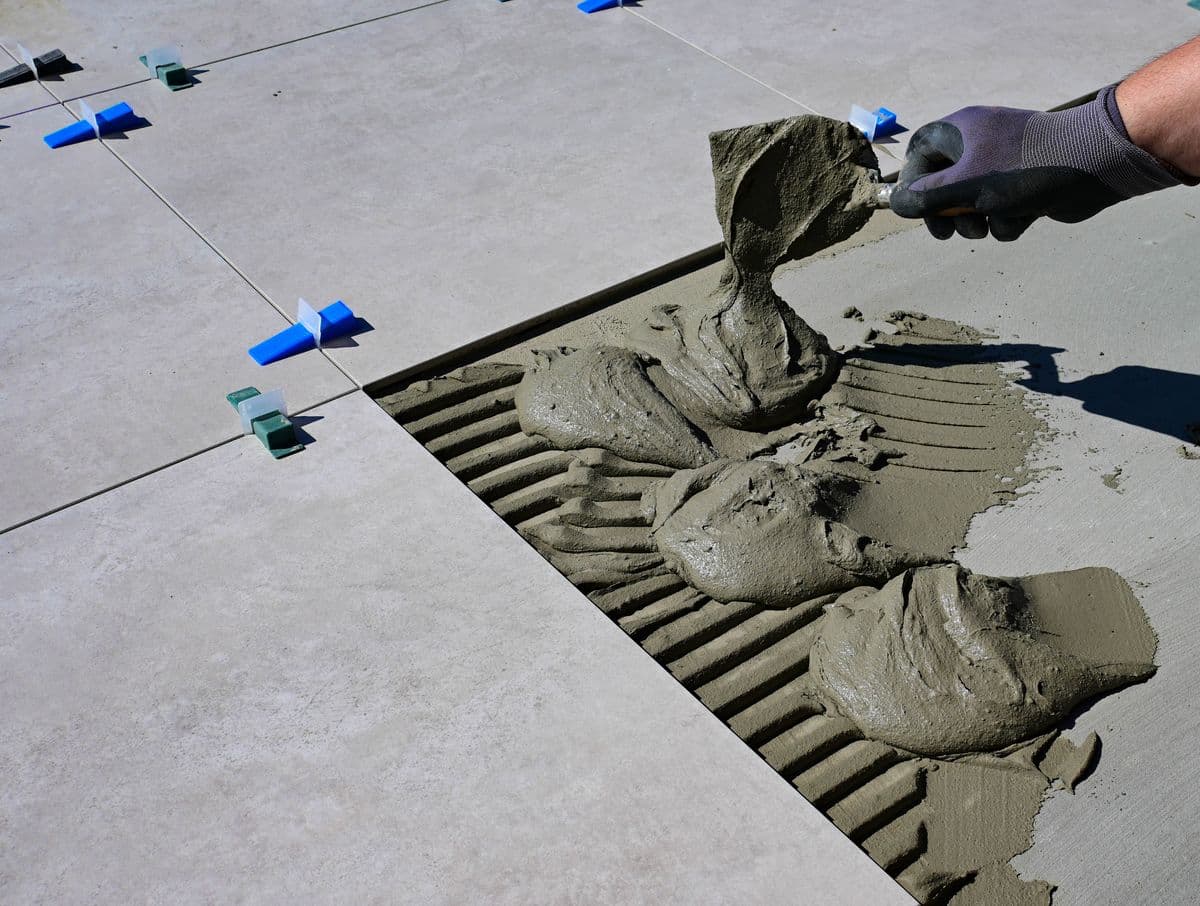
Tile adhesive selection follows from the tile, the substrate and the exposure, and getting it wrong is the leading cause of tile installation failure. Cementitious adhesives are classified by the standards in most markets according to bond strength class, whether they are fast setting, whether they have extended open time, whether they are slip resistant, and whether they are deformable or highly deformable. Those classifications exist because a large-format porcelain tile on a deflecting substrate needs a fundamentally different adhesive from a small ceramic tile on a rendered wall.
We specify adhesive against the actual installation: tile type and porosity, tile format and weight, substrate type and condition, wall or floor application, internal or external exposure, wet or dry service, whether there is underfloor heating, and whether the substrate will move. Large-format porcelain, low-porosity tile, external installation, swimming pools and heated floors each push the specification upward, and we say so rather than supplying a basic adhesive that meets a price.
Grout selection matters for both appearance and durability. Cementitious grouts are supplied in joint-width ranges and colour ranges, with additives for water repellency, flexibility and anti-fungal performance. Epoxy grouts cost considerably more and are specified where chemical resistance, stain resistance, hygiene or a very hard-wearing joint is required, such as in commercial kitchens, laboratories and food areas. Colour consistency between batches is a real issue in cementitious grout, and we control it by batch and warn where a job spans batches.
We also supply the ancillary products that determine whether an installation works: primers for absorbent and non-absorbent substrates, levelling compounds, decoupling and crack-isolation membranes, movement joint profiles and backing materials, and tile cleaners and protective sealers. A tile adhesive supplied without a primer for a dusty screed will fail through no fault of the adhesive, so we quote the system rather than the single item.
Sealants, waterproofing and system compatibility
Sealants are selected by movement capability, substrate adhesion and exposure rather than by appearance. Neutral-cure and acetoxy silicones cover glazing, sanitary and general applications, with sanitary grades containing fungicide for wet areas. Polyurethane sealants offer better abrasion resistance and paintability and are used for construction joints and flooring. Modified-silane polymer sealants combine good movement capability with paintability and adhesion without primer on many substrates. Acrylic sealants suit low-movement internal joints and are paintable and inexpensive.
Choosing a sealant requires knowing the joint: its width and depth, its expected movement as a percentage, the substrates on both faces, whether it will be painted, whether it is submerged or exposed to ultraviolet light, and whether there is chemical or food contact. A sealant applied in a joint designed wrongly will fail regardless of quality, so we supply joint design guidance with the product rather than assuming the applicator has it.
Waterproofing is a system rather than a product, and this is where most failures originate. We supply liquid-applied polymer and polyurethane membranes, cementitious flexible coatings, crystalline waterproofing admixtures and surface treatments, bituminous coatings and membranes, and injection systems for remedial work. Each requires specific surface preparation, priming, coating thickness, number of coats, reinforcement at corners and penetrations, and curing conditions, and each of those is a failure point if it is not followed.
System compatibility is checked rather than assumed. A waterproofing membrane must be compatible with the tile adhesive that will be applied over it, a primer must suit both the substrate and the product above it, and a sealant must be compatible with any coating applied over it. Mixing products from different manufacturers within one system is a common cause of failure, and we advise using a single manufacturer's system where the application is critical.
Technical data, safety documentation and compliance
Every product we ship is accompanied by a technical data sheet stating composition type, classification against the applicable standard, coverage and consumption rates, mixing ratios, pot life and open time, setting and curing times, service temperature range, substrate preparation requirements, application method and tools, and limitations. A product supplied without a data sheet cannot be used correctly and cannot be sold responsibly, and we treat the data sheet as part of the goods.
Safety data sheets are supplied in the format and language your market requires, covering hazard identification and classification, composition and hazardous ingredients, first-aid and firefighting measures, handling and storage requirements, exposure controls and personal protective equipment, physical and chemical properties, stability and reactivity, toxicological and ecological information, disposal considerations and transport information. Where your market requires a specific format or a local-language version, we arrange it before shipment.
Transport classification is checked for every product, because some construction chemicals are classified as dangerous goods for transport. Solvent-based products, certain sealants and adhesives, some admixtures and some cleaning products may carry a classification requiring specific packing, labelling, documentation and stowage. We identify these at quotation stage, arrange compliant packing and documentation, and tell you where a product's classification affects shipping cost or feasibility. Attempting to ship undeclared dangerous goods is not something we will do.
Market-specific compliance is confirmed before shipment rather than after. Requirements vary considerably and can include product registration, conformity marking, restrictions on specific substances, labelling and language requirements, and volatile organic compound content limits. We confirm what your destination requires and route production to a manufacturer whose product and documentation meet it, or tell you plainly if that is not achievable at your target price.
Shelf life, storage and batch control
Shelf life is the operational issue that separates construction chemicals from every other category we export. A cementitious adhesive typically has a shelf life measured in months from manufacture, and sea freight plus customs clearance plus your own stock turn can consume a large part of it. We manage this by scheduling production close to shipment rather than shipping stock that has been sitting in a warehouse, and by stating manufacturing date and expiry on every bag and carton.
We quote realistic remaining shelf life at the point of arrival, not at the point of manufacture, because that is the number that matters to a distributor. Where a product's shelf life is short relative to your transit and turnover, we say so and either propose a different product, a smaller and more frequent order pattern, or an air-freight component for fast-moving lines. Selling a distributor a container of adhesive that expires before it can be sold is a false economy for both sides.
Storage conditions are stated and they are not optional. Cementitious products must be kept dry and off the ground, since moisture ingress causes premature hydration and lumping that ruins the product without any visible sign until it is mixed. Sealants and liquid products have temperature limits, and freezing destroys most water-based products permanently. We supply storage guidance and, where the destination climate is extreme, factor it into packaging and product selection.
Batch control and traceability are maintained. Every bag, drum, cartridge and carton carries a batch number and manufacturing date, and batch records link to the quality control test results for that batch. Where a field problem arises, that traceability lets us establish whether the batch was in specification, which is the only basis for resolving a technical dispute properly.
Quality control and performance testing
Construction chemicals are tested by batch at the manufacturing unit and, where a buyer requires it, independently. For cementitious adhesives that means tensile adhesion strength after standard curing, after water immersion, after heat ageing and after freeze-thaw cycling, along with open time, slip resistance and, on deformable grades, transverse deformation. For grouts it means compressive and flexural strength, abrasion resistance, water absorption and, on epoxy grouts, chemical resistance.
For sealants, testing covers movement capability, adhesion and cohesion under cyclic movement, tensile properties, hardness, tack-free time and cure rate, resistance to ultraviolet light and weathering, and staining of porous substrates, which is a particular issue with some silicones on marble and natural stone. For waterproofing, testing covers water impermeability under pressure, crack-bridging ability, tensile strength and elongation, adhesion to substrate and resistance to water and alkali.
Admixture testing covers the effect on the concrete rather than the properties of the liquid: water reduction achieved, slump and slump retention, setting time modification, compressive strength development at specified ages, air content where relevant, and chloride content, which matters for reinforced concrete. An admixture data sheet without concrete trial data is of limited use, and for project supply we arrange trials with the buyer's actual cement and aggregates because admixture performance is materially affected by both.
We are candid about what testing can and cannot demonstrate. A batch test proves the batch was in specification when made; it does not prove the product will perform if stored badly, mixed wrongly, applied to an unprepared substrate or used outside its stated limits. Most construction chemical failures are application failures, and we support buyers with application guidance and, where volume justifies it, technical training material for their customers.
Packaging, branding and private label
Packaging in this category has to survive handling, protect against moisture and present the product for sale. Cementitious products are supplied in multi-wall paper sacks with polythene liner or in fully laminated woven sacks where humidity is a concern, palletised and hooded. Liquids are supplied in pails, drums, jerry cans and bottles with tamper-evident closures. Sealants are supplied in cartridges, sausages and foil packs, cartoned. Every pack carries product name, classification, batch, manufacturing date, expiry, mixing instructions, hazard labelling and coverage data.
Private label is common and straightforward in this category, and many distributors build their own construction chemical brand. We produce to your artwork with your brand, product names, colour scheme and data, and we ensure the technical claims printed on the pack match the actual tested classification of the product inside. That last point matters: a distributor printing a performance class on a bag is taking responsibility for it, and we will not print a class the product has not been tested to.
Multilingual labelling, market-specific hazard pictograms and regulatory text, barcodes and unit-level marking are all produced as required. For markets with specific labelling regulations we prepare artwork against the requirement and have it checked before printing, since a mislabelled hazardous product is a customs and liability problem rather than a cosmetic one.
Buying construction chemicals through us
The right conversation starts with the application, not the product name. Tell us what is being installed or built, on what substrate, in what exposure, with what tiles or materials, in what climate, and to what standard, and we will specify a system rather than quoting a list of products. Where you are replacing an existing supplier, sending their data sheets lets us match the classification honestly and show you where the products differ.
For distributors we plan the range: which products cover the majority of demand, which are specialist lines with slow turnover, how order frequency should be set against shelf life, and what packaging formats suit your customers. Construction chemicals reward a smaller range ordered more often over a broad range ordered annually, and we will advise accordingly even where it means a smaller first order.
Consolidation works well here. Construction chemicals ship efficiently alongside tiles, sanitary ware and other building materials, and pairing adhesive and grout with a tile shipment is both commercially sensible and technically better, since the adhesive is specified for the tile it will be laid with. We will plan the load, confirm the dangerous-goods position for any classified items and issue the complete documentation set.
Construction Chemicals specifications
| Tile adhesives | Cementitious adhesives in standard and improved classes, fast-set, extended open time, slip resistant and deformable grades |
|---|---|
| Grouts | Cementitious grouts by joint width with water-repellent and anti-fungal additives; epoxy grouts for chemical and hygiene applications |
| Sealants | Neutral and acetoxy silicone, sanitary grades, polyurethane, modified-silane polymer and acrylic |
| Waterproofing | Liquid polymer and polyurethane membranes, cementitious flexible coatings, crystalline systems, bituminous products, injection resins |
| Admixtures | Plasticisers, superplasticisers, retarders, accelerators, air-entraining agents with chloride content declared |
| Repair products | Repair mortars, micro-concretes, bonding agents, primers and anchoring grouts |
| Documentation | Technical data sheet and safety data sheet per product in your market's format and language |
| Traceability | Batch number, manufacturing date and expiry on every pack, linked to batch test records |
| MOQ | Product-level minimums by pack format; typically one pallet per product line, consolidated into container loads |
| Lead time | 25-40 days, with production scheduled close to shipment to preserve shelf life |
Made to your requirements
- System specification against your actual installation and substrate
- Private-label branding with verified performance claims
- Multilingual and market-compliant hazard labelling
- Concrete trials with your cement and aggregates for admixtures
- Order patterns planned around shelf life and stock turn
- Dangerous-goods compliant packing and documentation where classified
Where our construction chemicals is used
Typical buyer profiles and end uses we supply into.
Construction Chemicals export questions
The questions buyers ask most often before placing a first order.
How do I know which tile adhesive I need?
It follows from the tile, substrate and exposure, not from price. Tile type and porosity, format and weight, substrate type and condition, wall or floor, internal or external, wet or dry service, underfloor heating and expected substrate movement all push the specification. Large-format porcelain, low-porosity tile, external areas, pools and heated floors all need improved or deformable grades, and we specify accordingly rather than supplying a basic adhesive that meets a target price.
How much shelf life will be left when the goods arrive?
We quote remaining shelf life at arrival rather than at manufacture, because that is the number that matters to you, and we schedule production close to shipment instead of shipping warehouse stock. Where shelf life is short relative to your transit and stock turn, we will say so and propose a different product, smaller and more frequent orders, or air freight for fast-moving lines.
Are any construction chemicals restricted for shipping?
Yes. Solvent-based products, certain sealants and adhesives, some admixtures and some cleaners can be classified as dangerous goods, requiring specific packing, labelling, documentation and stowage. We identify classified items at quotation, arrange compliant packing and paperwork, and tell you where the classification affects cost or feasibility. We will not ship undeclared dangerous goods.
Can you supply construction chemicals under our own brand?
Yes, and many distributors do exactly that. We produce to your artwork with your brand, product names and data. The one firm condition is that printed technical claims must match the product's actual tested classification: printing a performance class on a bag makes you responsible for it, so we will not print a class the product has not been tested to.
Why do you insist on quoting a system rather than single products?
Because most failures in this category are system failures. An adhesive supplied without the right primer for a dusty screed fails through no fault of the adhesive; a waterproofing membrane incompatible with the adhesive above it fails at the interface. Mixing manufacturers within one system is a common cause of failure, so for critical applications we specify a single manufacturer's system.
Do admixture data sheets tell me how it will perform in my concrete?
Only partly. Admixture performance depends materially on the cement and aggregates used, so a data sheet gives indicative rather than actual figures. For project supply we arrange trials with your own cement and aggregates to establish real water reduction, slump retention and strength development, which is the only reliable basis for a mix design.
Request a quote: Construction Chemicals
Send your specification, quantity and destination market. We confirm feasibility, quote with a lead time and propose a sampling plan so your first order is judged on an approved sample.
- Response within 24 hours
- Samples before bulk commitment
- Full export documentation handled
Enquire about Construction Chemicals
Pre-filled for this product - just add your details.