Harvesters
Combine harvesters, reapers and threshers configured for the crop, yield and field conditions they will work in, supplied with spares and commissioning support.
At a glance
- Tractor-mounted, self-propelled and track combine options
- Crop-specific configuration for grain, paddy and pulses
- Reapers, reaper binders and stationary threshers
- Spares packages and wear-part supply with each order
- Commissioning and operator training support
Harvesting machinery is a system purchase
A harvester is the most complex and highest-value machine most farmers ever buy, and it is also the least forgiving of a poor specification. It must handle a specific crop at a specific moisture and yield, in specific field conditions, within a harvesting window measured in days. A machine that is wrong for the crop, or that cannot be supported with parts during the season, is not a partial success; it is a failure with severe consequences for the owner.
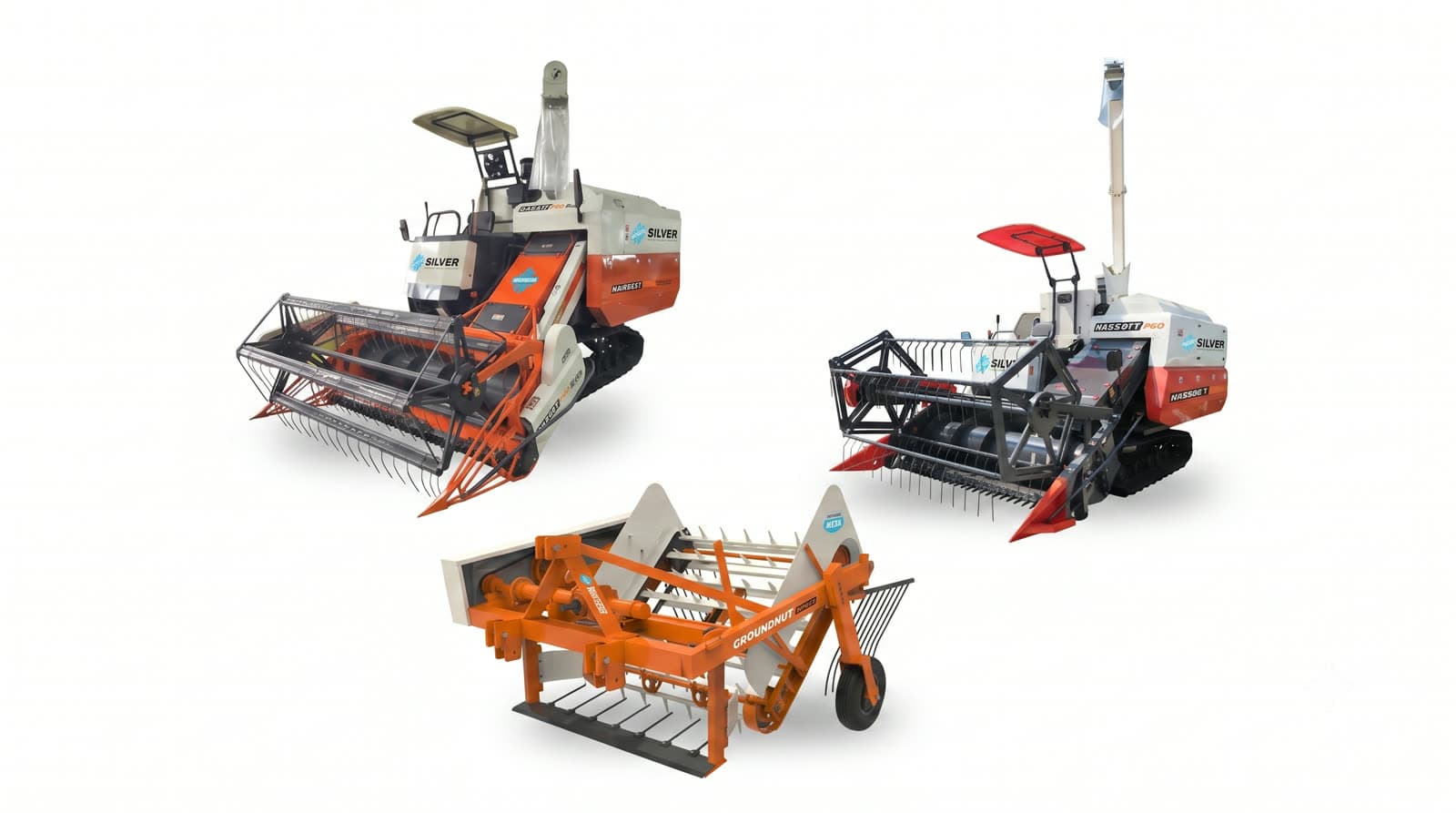
VP Global Exim exports harvesting machinery from India, where the domestic market's scale and diversity have produced machines well adapted to smallholder and mid-scale farming: tractor-mounted combine harvesters that use the tractor as the power unit, self-propelled wheeled combines, track-type combines for wet and paddy conditions, self-propelled and tractor-mounted reapers and reaper binders, and stationary threshers for grain, paddy, maize and pulses.
We are deliberately careful with this category. Harvesters demand serious after-sales capability, and we will only supply into a situation where the buyer can support the machines - or where we can help build that support. Selling a container of combines to a distributor with no workshop, no trained technicians and no spares stock is a disservice regardless of the margin, and we say so at the enquiry stage.
Machine types and where each fits
Tractor-mounted combine harvesters use the farmer's existing tractor as the power source, which makes them substantially cheaper than self-propelled machines and attractive where capital is constrained and a suitable tractor is already owned. They require a tractor of adequate power and are less productive and less comfortable than self-propelled machines, but for many smallholder and contractor situations they are the economically correct answer.
Self-propelled wheeled combines are the mainstream mechanised harvesting solution, offering higher output, better operator conditions and greater capability. They are a much larger capital commitment and require competent operation and maintenance. Track-type combines replace wheels with rubber tracks and are the correct specification for wet field conditions, particularly paddy, where a wheeled machine sinks and cannot work.
Reapers and reaper binders cut the crop and either lay it in a windrow or bind it into sheaves for later threshing. They are far cheaper than combines, suit smaller holdings and crops that are traditionally threshed separately, and remain a very large market. Stationary threshers then separate grain from the cut crop and are supplied crop-configured for wheat, paddy, maize, pulses and oilseeds.
Which machine is right depends on holding size, crop, field conditions, labour availability, capital and whether the buyer is a farmer or a contract harvesting operator. Contract operators need output and reliability above all and can justify self-propelled machines; individual smallholders often cannot. We discuss the economics honestly rather than promoting the highest-value machine.
Crop configuration and header specification
A combine is configured for the crop, and the configuration is not trivial. Threshing drum type and speed, concave clearance and type, cleaning fan speed and sieve selection, straw walker or rotary separator arrangement, and header type all change between wheat, paddy, maize, soybean and pulses. A machine set up for wheat and used on paddy will produce unacceptable grain loss and damage, and vice versa.
We specify the crop or crops the machine must handle and supply it configured accordingly, with the additional drums, concaves, sieves and settings needed where the machine must handle more than one crop. Where a buyer's market harvests several crops through the season, we supply the changeover parts with the machine and ensure the operator manual covers the settings, because a machine that could handle a second crop but has not been supplied with the parts effectively cannot.
Header specification covers cutting width, reel type and speed, cutter bar and knife section quality, crop lifters for lodged crops, and the auger and feeder arrangement. Cutting width must match the machine's threshing capacity and the field's yield: a wide header on a high-yielding crop overloads the threshing system and produces losses. We size the header to the actual yield rather than to the maximum the machine can physically carry.
Grain loss is the measure that matters and it is worth insisting on. A harvester's value is the grain it saves, and losses occur at the header, in threshing, in separation and in cleaning. Machines should be assessed on total loss under representative conditions rather than on throughput alone, and we ask manufacturers for loss data and, where a significant order justifies it, arrange field demonstration in the buyer's crop.
Build quality, wear parts and durability
Harvesters work in abrasive, dusty conditions for intense periods, and their durability is determined by the quality of components that wear. Cutter bar knife sections and ledger plates, threshing drum bars and rasp bars, concave wires, sieve and chaffer components, elevator chains and slats, augers and flighting, belts, chains and bearings throughout, and the grain tank and unloading auger all wear and all need to be of adequate quality.
We inspect the specification of these components rather than accepting a machine as a whole. Bearing quality and sizing, chain and belt specification, drive tensioning arrangements, and the accessibility of lubrication points all indicate whether a machine was designed to be maintained. A harvester with inaccessible grease points will not be greased, and it will fail.
Structural and frame quality matters because a harvester is subject to continuous vibration. Frame welding, the mounting of heavy components such as the threshing drum and engine, and the design of the header attachment are inspected. Cracking at the header attachment and at engine mounts is a classic failure on poorly built machines and is very expensive to repair in the field.
Engine and transmission on self-propelled machines are the highest-value components and their support matters as much as their specification. We prefer machines using engines with established parts and service availability in the destination market, because an orphan engine with no local parts support turns a repairable breakdown into a scrapped machine. We raise this explicitly at specification because buyers frequently overlook it.
Spares, service capability and season readiness
Harvesting has no tolerance for downtime. A combine out of action for a week during the harvest window can cost its owner more than the machine's value in lost and degraded crop, so parts availability is not an after-sales consideration but a core part of the purchase. We treat spares as part of the specification and quote them with the machines rather than after.
A recommended spares package covers the fast-moving wear parts: knife sections, ledger plates and knife bolts, threshing bars and concave components, sieve and chaffer parts, elevator chains and slats, belts and chains throughout, bearings for the main drives, filters for engine, hydraulic and air systems, and hydraulic hoses and seals. We size the package against the number of machines and the expected season hours.
Service capability is discussed candidly with distributors before we supply. Harvesters need a workshop with appropriate tools and lifting capability, technicians trained on the specific machine, a parts inventory with a re-order process, and the ability to respond within days rather than weeks during the season. Where a distributor is building this capability, we support it with training, documentation and parts planning; where a buyer does not intend to build it, we advise against the purchase.
We can arrange commissioning support and operator training with an initial shipment, including assembly and pre-delivery inspection procedures, machine setup for the local crop, operator training on settings and loss assessment, and technician training on maintenance and common repairs. This is the single highest-value thing a buyer can add to a first harvester order, and it substantially reduces first-season problems.
Safety, guarding and operator protection
Harvesters contain many high-energy rotating and reciprocating components and they are responsible for serious injuries every season. Machines must be supplied with complete guarding over drives, chains, belts, augers and the header, with guards secured and in good condition, and with the safety interlocks the design provides in working order. We do not accept machines with guards missing or deleted.
Operator protection on self-propelled machines includes the cab or canopy structure, adequate visibility, accessible and clearly marked controls, safe access steps and handrails, and protection from dust and noise. A machine with poor access is a machine whose operator will take shortcuts, and shortcuts around a harvester cause injuries.
Fire risk deserves specific mention because harvester fires are common and destructive. Dry crop material accumulating around a hot engine and exhaust is the cause, and the mitigations are effective engine bay design, accessible cleaning points, adequate shielding around the exhaust, and a fire extinguisher supplied and mounted on the machine. We specify an extinguisher as standard and include cleaning guidance prominently in the operator material.
Safety decals and operator manuals are supplied in the destination language, covering guard replacement, safe unblocking procedures with the machine stopped, transport locking, header support when working underneath, and the risk of entanglement. Unblocking a header with the machine running is the classic fatal accident in this category, and the warning has to be in a language the operator reads.
Shipping, assembly and pre-delivery
Harvesters are large and require partial disassembly for shipping. Headers are typically removed and shipped separately, elevators and augers may be detached, and cabs or canopies may be lowered or removed. Components are secured, protected against contact damage, and packed with all fasteners bagged and labelled against an assembly drawing. Self-propelled machines may ship as flat-rack or break-bulk cargo where they exceed container dimensions, and we plan and quote the shipping mode explicitly.
An assembly and pre-delivery inspection procedure is supplied with every shipment, covering reassembly sequence, torque values for structural fasteners, hydraulic connection and bleeding, electrical connection, fluid levels and specifications, belt and chain tensioning, initial lubrication, and functional checks before delivery to the end user. A harvester delivered without a proper pre-delivery inspection will have problems in its first week.
Documentation includes the operator manual, parts catalogue with exploded diagrams and part numbers, service manual with maintenance schedules and repair procedures, wiring and hydraulic diagrams, and the certificate of conformity and any required compliance documentation. The parts catalogue is essential rather than optional: a distributor cannot order the right part without it.
Discussing a harvester requirement with us
The conversation we need is about the farming system, not the machine. Tell us the crops and their sequence through the season, typical yields, field sizes and conditions including wetness, holding sizes and whether buyers are farmers or contract operators, existing tractor fleet if tractor-mounted machines are relevant, the capital available, and critically the service and parts capability you have or intend to build.
From that we will propose machine types and configurations with honest commentary on what each will and will not do, quote with spares packages, set out lead times and shipping mode, and outline the commissioning and training support we would recommend for a first order. Where we think a buyer's plan will not work - a machine unsuited to the crop, or an order with no service capability behind it - we will say so plainly.
For a first order we strongly recommend a small quantity with full spares, commissioning support and training, and a field demonstration in the actual crop before committing to volume. Harvesters are the category where a rushed first order does the most damage, and where a careful one builds a business that lasts for years.
Harvesters specifications
| Machine types | Tractor-mounted combines, self-propelled wheeled combines, track combines, reapers, reaper binders, stationary threshers |
|---|---|
| Crop configuration | Drum type and speed, concave clearance, fan speed and sieve selection configured per crop with changeover parts supplied |
| Header | Cutting width sized to threshing capacity and field yield, with reel type, knife sections, crop lifters and feeder arrangement specified |
| Track option | Rubber track undercarriage specified for wet field and paddy conditions |
| Wear parts | Knife sections, ledger plates, threshing and rasp bars, concave wires, sieves, elevator chains, belts and bearings specified and stocked |
| Engine support | Preference for engines with established parts and service availability in the destination market |
| Safety | Complete guarding, interlocks, mounted fire extinguisher, local-language decals and manuals |
| Documentation | Operator manual, parts catalogue with exploded diagrams, service manual, wiring and hydraulic diagrams |
| MOQ | Assessed per machine type; first orders deliberately small with full spares and commissioning support |
| Lead time | 60-90 days depending on machine type, configuration and shipping mode |
Made to your requirements
- Crop-specific configuration with changeover parts for multi-crop seasons
- Header width sized to actual field yield
- Track undercarriage for wet and paddy conditions
- Spares packages sized to fleet and season hours
- Commissioning, pre-delivery inspection and operator training support
- Local-language manuals, decals and parts catalogues
Where our harvesters is used
Typical buyer profiles and end uses we supply into.
Harvesters export questions
The questions buyers ask most often before placing a first order.
Can one combine handle several different crops?
Yes, but only if it is supplied with the changeover parts. Drum type and speed, concave clearance, fan speed and sieve selection all differ between wheat, paddy, maize and pulses, and a machine set up for wheat used on paddy produces unacceptable loss and grain damage. We supply the additional drums, concaves and sieves with the machine and make sure the manual covers the settings.
Should I choose a tractor-mounted or self-propelled combine?
It depends on the economics rather than the specification. Tractor-mounted machines use an existing tractor and are much cheaper, which suits capital-constrained smallholders and small contractors, though they are less productive. Self-propelled machines offer higher output and better operator conditions but are a far larger commitment needing competent maintenance. We discuss the economics honestly rather than promoting the higher-value machine.
Why do you ask about our service capability before quoting?
Because a combine out of action for a week during harvest can cost its owner more than the machine's value in lost crop. Harvesters need a workshop, trained technicians, parts inventory and days-not-weeks response during the season. Where you are building that, we support it with training and parts planning. Where you are not, we will advise against the purchase rather than take the order.
How should I compare two harvesters?
On total grain loss under representative conditions, not throughput. A harvester's value is the grain it saves, and losses occur at the header, in threshing, separation and cleaning. We request loss data from manufacturers and, where the order size justifies it, arrange a field demonstration in your actual crop, which is far more informative than a specification sheet.
Does the engine brand matter?
As much as the machine. An engine with no local parts or service support turns a repairable breakdown into a scrapped machine. We prefer machines using engines with established availability in the destination market and we raise it explicitly at specification, because buyers routinely focus on the harvesting system and overlook the power unit behind it.
What support do you recommend on a first harvester order?
A small quantity with a full spares package, commissioning support, pre-delivery inspection procedures, operator training on settings and loss assessment, technician training on maintenance, and a field demonstration in the actual crop before committing to volume. This is the highest-value addition any first harvester order can carry, and it prevents most first-season problems.
Request a quote: Harvesters
Send your specification, quantity and destination market. We confirm feasibility, quote with a lead time and propose a sampling plan so your first order is judged on an approved sample.
- Response within 24 hours
- Samples before bulk commitment
- Full export documentation handled
Enquire about Harvesters
Pre-filled for this product - just add your details.