Seed Planters
Seed drills and precision planters configured for your crop, row spacing and seed rate, with metering systems that place seed accurately rather than merely distributing it.
At a glance
- Seed cum fertiliser drills, zero-till drills and planters
- Precision metering with calibration charts supplied
- Row spacing and coulter type configured to crop
- Tractor-mounted and trailed configurations
- Metering component spares supplied with orders
Placement is what a planter is for
A seed drill's job is not to distribute seed but to place it: at the right depth, at the right spacing, in firm contact with moist soil, with fertiliser positioned where the emerging plant can use it. Every one of those is a mechanical function that either works or does not, and the difference between a planter that places seed properly and one that scatters it appears in the yield rather than in the specification sheet. VP Global Exim specifies planters against crop, seed rate, row spacing and soil condition for exactly that reason.
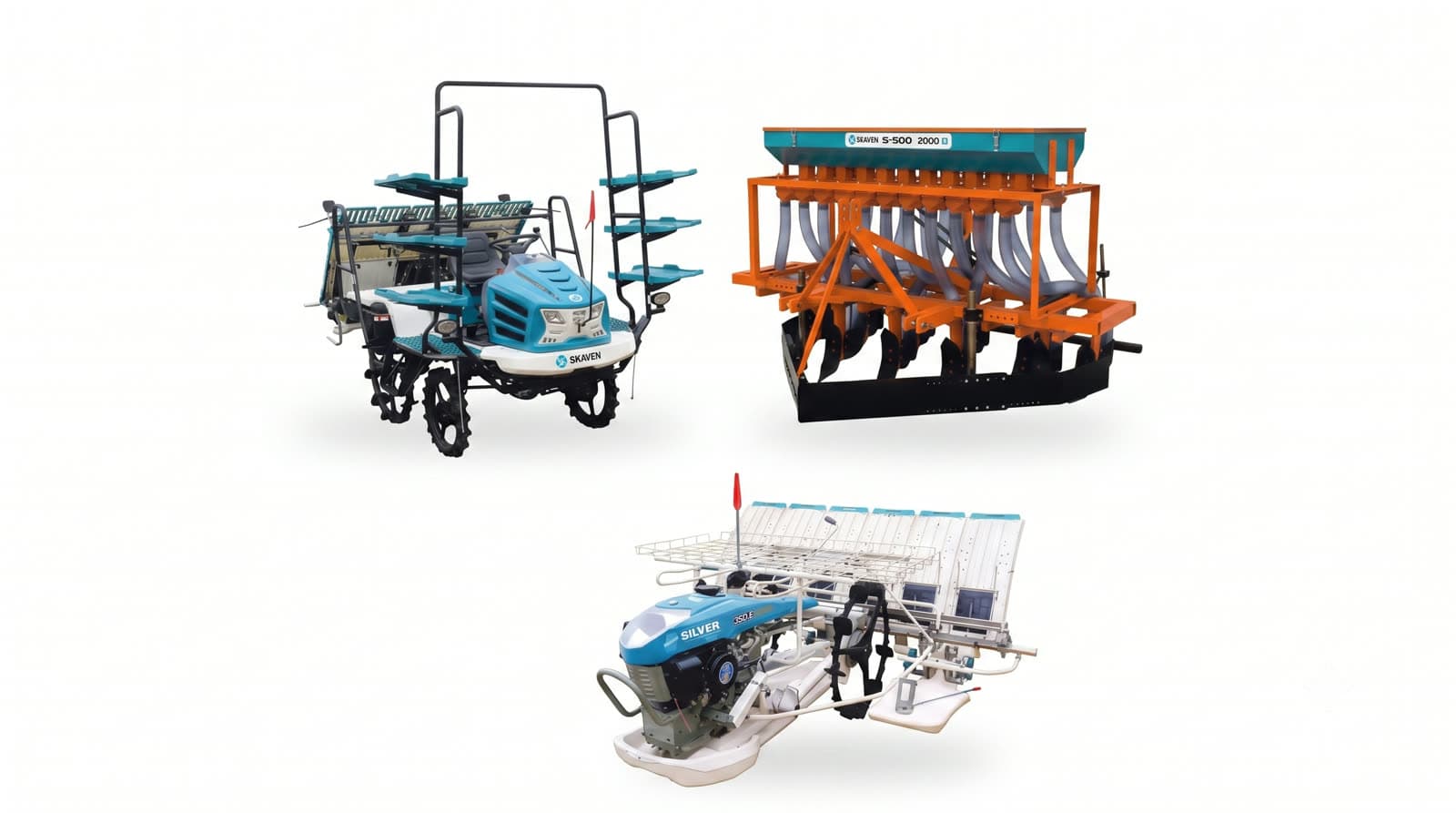
We export sowing machinery from India across the range used by smallholder and mid-scale mechanised farming: seed cum fertiliser drills that place seed and fertiliser in one pass, zero-till and no-till drills that sow directly into stubble without prior tillage, precision planters with individual row metering for crops requiring accurate plant spacing, multi-crop planters configurable across crop types, raised-bed planters and combined bed-former planters, and manual and animal-drawn planters for the smallest holdings.
Applications include cereal sowing for wheat and other small grains, paddy direct seeding, row crops including maize, cotton, soybean, groundnut and sunflower, pulses and oilseeds, vegetable seed sowing, and fodder crops. Row spacing, seed rate, seed size and depth requirement differ across all of these, and a planter has to be configured rather than simply purchased.
Metering systems and seed rate accuracy
The metering system is the heart of a planter and the main determinant of its quality. Fluted roller metering is common on seed cum fertiliser drills, is simple and robust and handles a range of seed sizes, and its rate is adjusted by changing the exposed roller length and the drive ratio. Inclined plate and cell wheel metering handles larger seeds more gently. Vacuum and pneumatic precision metering singulates seed for accurate plant-to-plant spacing and is used where plant population matters, as in maize and cotton.
Seed damage is a real and under-appreciated issue. A metering system that cracks or scuffs seed reduces germination, and the damage is invisible until emergence is patchy. Metering component design, clearances, drive speed and material all affect it, and it is worse on large, soft or treated seeds. Where a buyer's crops include seeds vulnerable to mechanical damage, we specify gentler metering rather than the cheapest available option.
Rate accuracy and consistency across rows determines whether the field is sown evenly. A drill whose rows deliver different rates produces visibly uneven crop, and the cause is usually uneven metering drive, blocked or worn components, or poor distribution in the seed box. We check row-to-row variation on samples and we supply calibration charts for the crops and rates the buyer will use, since a drill without a calibration chart is set by guesswork.
Calibration procedure is part of the product. Every drill is supplied with a calibration method and chart relating metering setting to seed rate for the crops specified, and where the buyer's seed differs from the chart's assumptions we explain how to recalibrate. Seed size and density vary by variety and by season, so a farmer needs to be able to check rather than trust a printed setting, and the manual has to explain how.
Fertiliser placement and dual metering
Seed cum fertiliser drills place fertiliser as well as seed, and placement geometry matters. Fertiliser placed in direct contact with seed can damage germination through salt effect, so it is normally placed to the side of and below the seed, or in a separate band. The drill's tube and coulter arrangement determines whether that separation is actually achieved, and a drill whose fertiliser lands in the seed furrow will cause damage regardless of the rate used.
Fertiliser metering has to cope with a difficult material. Granular fertiliser is abrasive, hygroscopic, corrosive and prone to bridging and caking, and it destroys metering components that were designed for seed. Fertiliser metering components and boxes must be made from materials that resist corrosion, and the box must be designed so it can be emptied and cleaned at the end of use. A fertiliser box left full overnight in humid conditions can be solid by morning.
We specify corrosion-resistant metering components and box linings, adequate agitation to prevent bridging, and accessible cleanout points, and we make cleaning guidance prominent in the operator material. This is one of the most common causes of a drill working well in its first season and poorly thereafter, and it is entirely preventable by construction and by user practice.
Separate rate control for seed and fertiliser is necessary because the rates are unrelated. Independent drive ratios or metering adjustments allow each to be set correctly, and a drill in which changing seed rate also changes fertiliser rate forces a compromise on one of them. We confirm the drill provides independent adjustment and that calibration charts cover both.
Coulters, openers and depth control
The furrow opener determines whether seed reaches moist soil at a consistent depth, and the right type depends entirely on soil condition and residue. Shoe and boot openers are simple and work well in prepared, clean soil. Single and double disc openers cut through residue and work in harder ground and are essential for zero-till operation. Tyne and shovel openers handle rough conditions. Inverted-T openers are used in specific zero-till applications.
Zero-till drilling makes the highest demands on the opener because it must cut through standing stubble and undisturbed soil. That requires adequate down pressure, sharp discs of sufficient diameter and correct hardness, effective residue management ahead of the opener, and enough weight in the machine to keep the openers in the ground. A drill nominally described as zero-till but lacking down pressure and disc quality will simply ride out of the ground in hard conditions.
Depth control determines emergence uniformity. Gauge wheels adjacent to each opener control depth row by row and are far more accurate than a machine relying on frame height alone, which varies with soil undulation. Press wheels behind the opener close the furrow and firm the soil around the seed, which is what establishes seed-to-soil contact. We specify individual row depth control and press wheels where placement accuracy matters, since these components are exactly what a low-cost drill omits.
Row unit mounting affects performance on uneven ground. Parallelogram or pivoting row units maintain opener angle and depth as the ground undulates; rigidly mounted units do not. For precision planting on anything other than flat, uniform fields, row unit mounting is one of the most significant specification decisions and we raise it explicitly.
Frame, transmission and build quality
The frame carries the seed and fertiliser boxes, the metering drive and the row units, and it must hold the row units in correct alignment and spacing under load. Frame rigidity, the design of row unit mounting, and the linkage attachment are inspected. A frame that flexes changes row spacing and opener angle in work, which shows up as uneven rows in the field.
Row spacing must be configurable and the configuration must hold. Clamped row units on a toolbar allow spacing to be set for the crop, and the clamping must be secure enough that units do not creep along the bar in work. We confirm the spacing range available and that the clamping arrangement is adequate, since row units that shift in work produce a field with irregular spacing that is impossible to inter-cultivate.
Metering drive transmission is usually from a ground wheel, which is correct because seed rate should be proportional to distance travelled rather than to time. Ground wheel slip is therefore an accuracy issue, and adequate wheel diameter, tread and weight matter. Chain and sprocket drives need guarding and tensioning; where a drill uses a chain drive, we check the guard, the tensioner and the accessibility for maintenance.
Seed and fertiliser boxes need adequate capacity for the working width so refilling does not dominate the operation, effective lids that keep out rain and dust, sight windows or level indication, and accessible cleanout. A box with no cleanout means seed and fertiliser residue remains between uses, which contaminates the next crop and corrodes the metering.
Configuration, calibration and field setup
A planter arrives configured but must be set up for the field. Row spacing set for the crop, seed and fertiliser rates calibrated against the actual seed, opener depth set for soil moisture, down pressure adjusted for soil hardness, press wheel pressure set for the conditions, and level and pitch of the frame adjusted on the linkage. We supply written setup procedures covering each of these and we support distributors in training their staff to do it.
Field checking is the step most often skipped. After setting up, the operator should sow a short distance, then dig to verify seed depth, spacing and fertiliser separation, and adjust before committing the field. This takes minutes and prevents sowing an entire field at the wrong depth. We put it prominently in the operator material because it is the single most valuable habit a planter operator can have.
For distributors we can supply calibration charts covering the crops and seed types common in their market rather than generic charts, along with a setup and pre-delivery inspection checklist so machines reach farmers correctly assembled and adjusted. A planter delivered with the metering drive chain slack and the openers at the wrong depth will be judged as a poor machine when it is actually a poorly delivered one.
Spares, wear parts and support
Sowing has a narrow window and a breakdown in it is costly. Wear and consumable parts on planters include opener discs, shoes, shovels and points, gauge and press wheel bearings and tyres, metering rollers, plates and cell wheels, seed and fertiliser tubes, drive chains and sprockets, ground wheel bearings, and fasteners. Opener points and discs wear fastest, and metering components are the parts whose wear most affects performance.
We quote spares with the machines and recommend distributors stock openers, metering components and bearings above all. A worn metering roller quietly changes the seed rate, so its replacement is a performance issue rather than a breakdown issue, and farmers rarely realise it needs doing. Advising them of it is a useful service a distributor can provide.
Documentation supplied includes the operator manual with setup, calibration and maintenance procedures, calibration charts for the specified crops, a parts catalogue with exploded diagrams and part numbers, and safety information. Local-language documentation is arranged where the market requires it, and we regard the calibration chart as the most important single document in the pack.
Specifying a planter with us
To quote we need the crops to be sown, the row spacings required, the seed rates, whether fertiliser placement is needed, whether zero-till or conventional sowing, the tractor horsepower and linkage category, soil type and residue conditions, the working width required, and quantities. Where a buyer serves several crops, tell us all of them, because a multi-crop planter needs the metering components for each.
We will respond with a configuration proposal, quotation, lead time, a spares recommendation, and observations where the requirement looks inconsistent. A common example is a request for a wide zero-till drill behind a modest tractor: zero-till openers need down pressure and machine weight, and a light machine will not penetrate. Saying so before shipment is considerably better than after.
For a first order we recommend a modest quantity with metering spares and a field trial in the buyer's actual crop and soil, particularly for zero-till and precision planting where performance depends heavily on local conditions. Planters are configurable enough that a trial usually leads to a better specification for the volume order, and that is worth the delay.
Seed Planters specifications
| Machine types | Seed cum fertiliser drills, zero-till and no-till drills, precision planters, multi-crop planters, raised-bed planters, manual and animal-drawn planters |
|---|---|
| Metering | Fluted roller, inclined plate, cell wheel and vacuum precision metering, selected for seed size and damage sensitivity |
| Rate control | Independent seed and fertiliser rate adjustment with calibration charts for specified crops |
| Fertiliser handling | Corrosion-resistant metering and box lining, anti-bridging agitation, accessible cleanout, side-and-below placement geometry |
| Openers | Shoe and boot, single and double disc, tyne and shovel, and inverted-T openers by soil and residue condition |
| Depth control | Individual row gauge wheels and press wheels; parallelogram or pivoting row unit mounting for uneven ground |
| Row spacing | Configurable clamped row units on toolbar with secure clamping verified against creep in work |
| Drive | Ground-wheel driven metering with adequate wheel diameter, tread and weight to limit slip |
| MOQ | 10-25 units per model; mixed configurations consolidated per container |
| Lead time | 40-60 days depending on configuration, metering type and quantity |
Made to your requirements
- Row spacing and opener type configured to crop and soil
- Metering selected for seed size and damage sensitivity
- Zero-till configuration with adequate down pressure and disc specification
- Calibration charts prepared for your market's crops and seed types
- Setup and pre-delivery inspection checklists for your workshop
- Metering and opener spares packages with each order
Where our seed planters is used
Typical buyer profiles and end uses we supply into.
Seed Planters export questions
The questions buyers ask most often before placing a first order.
Why is the metering system so important?
Because it determines both seed rate accuracy and seed damage. A system that cracks or scuffs seed reduces germination invisibly until emergence is patchy, and row-to-row rate variation produces visibly uneven crop. We select metering type for seed size and damage sensitivity rather than by price, check row-to-row variation on samples, and supply calibration charts for the crops you actually sow.
Can I use a standard drill for zero-till sowing?
Generally not. Zero-till openers must cut through standing stubble and undisturbed soil, which needs adequate down pressure, sharp discs of sufficient diameter and hardness, effective residue management ahead of the opener, and enough machine weight to keep openers in the ground. A drill described as zero-till without down pressure and disc quality simply rides out in hard conditions.
Why does fertiliser placement geometry matter?
Because fertiliser in direct contact with seed damages germination through salt effect. It should be placed to the side of and below the seed or in a separate band, and the tube and coulter arrangement determines whether that separation is actually achieved. A drill whose fertiliser lands in the seed furrow causes damage regardless of the rate used.
Why do fertiliser boxes and metering fail?
Because granular fertiliser is abrasive, hygroscopic and corrosive, and it destroys components designed for seed. A box left full overnight in humid conditions can be solid by morning. We specify corrosion-resistant metering and box lining, anti-bridging agitation and accessible cleanout, and we make cleaning guidance prominent, because this is the usual reason a drill works well in season one and poorly afterwards.
How important are gauge wheels and press wheels?
They are what turn distribution into placement. Gauge wheels adjacent to each opener control depth row by row, far more accurately than a machine relying on frame height that varies with soil undulation. Press wheels close the furrow and firm soil around the seed, establishing the seed-to-soil contact that emergence depends on. These are exactly the components a low-cost drill omits.
What should an operator check before sowing a field?
Sow a short distance, then dig to verify seed depth, plant spacing and fertiliser separation, and adjust before committing the field. It takes minutes and prevents sowing an entire field at the wrong depth. It is the most valuable habit a planter operator can have, and we put it prominently in the operator material along with the setup procedure.
Request a quote: Seed Planters
Send your specification, quantity and destination market. We confirm feasibility, quote with a lead time and propose a sampling plan so your first order is judged on an approved sample.
- Response within 24 hours
- Samples before bulk commitment
- Full export documentation handled
Enquire about Seed Planters
Pre-filled for this product - just add your details.