Electric Motors
Single and three-phase induction motors for pump, irrigation and general agricultural duty, wound to your destination's voltage and frequency and routine tested before dispatch.
At a glance
- 0.5 HP to 10 HP and above, single and three-phase
- Wound for 110V, 220-240V, 380-415V at 50 or 60 Hz
- Copper windings with declared insulation class
- IP-rated enclosures for field and outdoor duty
- Routine electrical test certificate per motor
Motors specified for the destination, not the catalogue
An electric motor is the one product where a specification error makes the goods completely useless rather than merely disappointing. A motor wound for 415 volts at 50 hertz will not run correctly on a 220 volt 60 hertz supply, and no amount of installation skill will fix it. VP Global Exim therefore begins every motor enquiry with the destination's electrical supply characteristics, because that single piece of information determines the winding, the nameplate, the performance and whether the shipment has any value at all.
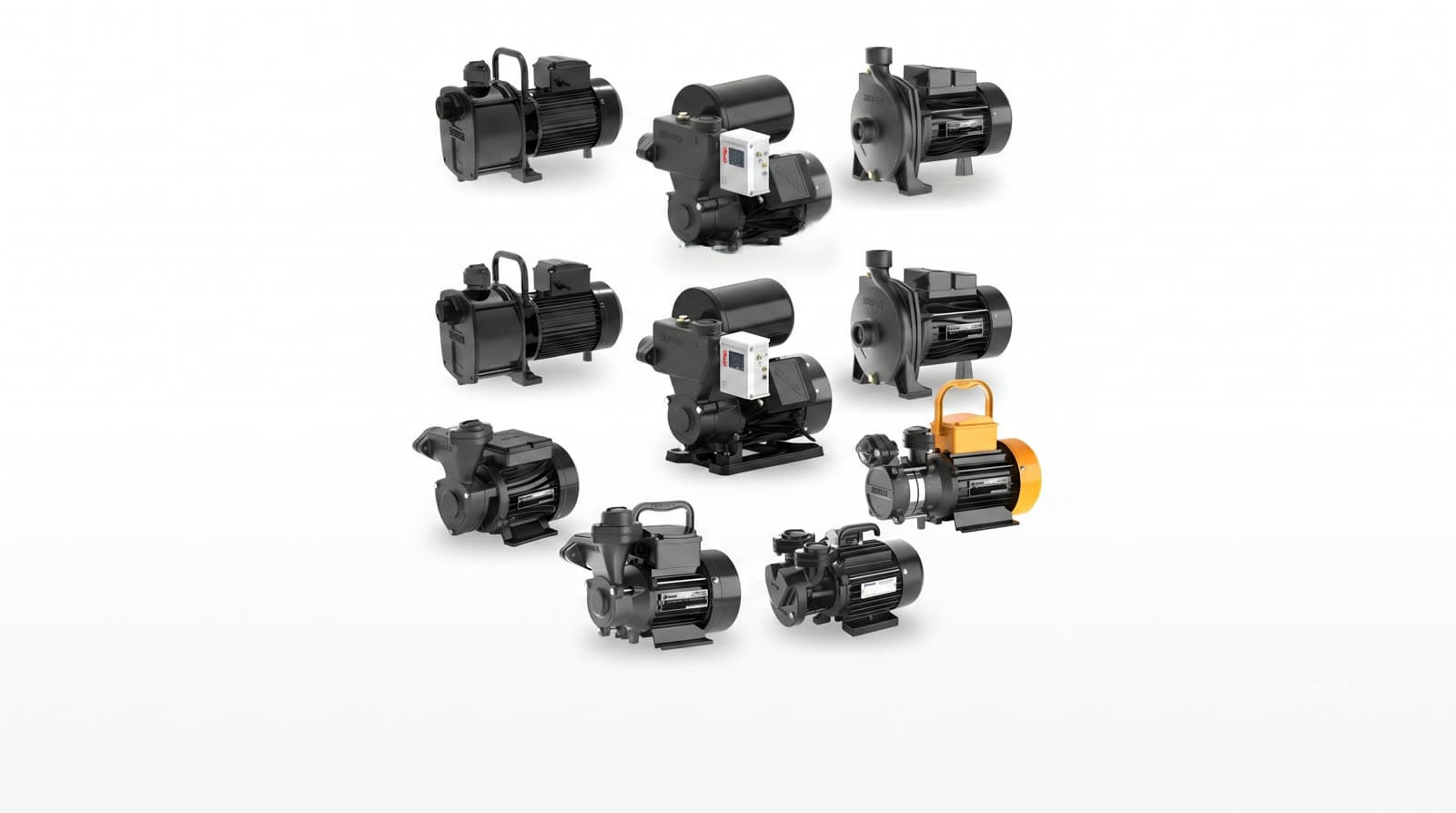
We export single-phase and three-phase squirrel-cage induction motors from India's substantial motor manufacturing base, in the ratings that agricultural and general industrial buyers actually need: fractional ratings from around 0.5 horsepower, through the mainstream 1 to 5 horsepower band used for pumps and small machinery, up to 10 horsepower and above for larger pump sets and equipment. Foot-mounted, flange-mounted and face-mounted constructions are available, along with monoblock and pump-specific configurations.
The applications we supply into are mainly water pumping from wells, borewells, tanks and canals, irrigation systems, agricultural processing equipment such as chaff cutters, threshers, flour mills and oil expellers, small workshop machinery, and general-purpose drives for equipment manufacturers. Each has different duty, starting and enclosure requirements, and the correct motor differs accordingly.
Voltage, frequency and winding specification
Voltage and frequency must both be specified, and they interact. A motor wound for 50 hertz running on 60 hertz will turn approximately 20 percent faster, which changes the load it presents if it is driving a pump or fan, since both are speed-sensitive loads. Conversely, a 60 hertz motor on a 50 hertz supply runs slower and can overheat if the voltage is not correspondingly reduced. We wind motors for the actual destination supply rather than adapting a standard unit.
Common configurations we supply are single-phase 110V/60Hz, single-phase 220-240V/50Hz, single-phase 220V/60Hz, three-phase 380-415V/50Hz and three-phase 220V or 440V/60Hz. Dual-voltage windings with terminal reconnection are available where a buyer serves more than one supply standard, and we mark the terminal box and supply the connection diagram clearly, because an incorrectly connected dual-voltage motor fails immediately.
Supply voltage stability at destination is a genuine specification input in many agricultural markets. Where mains voltage fluctuates widely, a motor designed for a narrow tolerance band will suffer. We specify motors with a wider voltage tolerance where the destination requires it, recommend appropriate protection, and advise on starter and protection specification rather than supplying a motor alone into an unstable supply and waiting for the warranty claim.
Single-phase starting arrangement is specified because it determines starting torque. Capacitor-start motors give good starting torque and are appropriate for pumps and loaded starts. Capacitor-start capacitor-run designs improve running efficiency and power factor. Split-phase and shaded-pole designs have low starting torque and suit only light loads. Supplying a split-phase motor for a submersible pump application is a guaranteed failure, and the distinction has to be made at specification rather than at installation.
Windings, insulation and thermal design
Winding material is the most common place where motor cost is cut invisibly. Copper windings are the standard specification and give better efficiency, better thermal performance and longer life. Aluminium windings are cheaper and are used in low-cost motors; they have higher resistance, run hotter and are less durable, particularly under the frequent starting and voltage fluctuation typical of agricultural supply. We state the winding material explicitly and we do not substitute aluminium for copper to meet a price.
Insulation class defines the temperature the winding insulation can withstand, and it must match the duty and ambient temperature. Class B and Class F insulation cover most agricultural applications, with Class F preferred where ambient temperatures are high, as they are in most of the markets we supply. Class H is specified for severe duty. We state the insulation class and the corresponding temperature rise limit, and we verify it rather than accepting a nameplate claim.
Thermal design determines whether a motor survives its duty. Frame size relative to rating, cooling fan and cowl design, ventilation path, and the ratio of iron and copper all decide operating temperature. An undersized frame carrying a high nameplate rating will run hot and fail early, and this is one of the ways a cheap motor is made cheap. We check frame size against the rating, since a motor rated well above what its frame size normally carries is a warning sign.
Thermal protection is specified where the application justifies it. Built-in thermal overload protectors, thermistors or thermostats embedded in the winding protect against overheating from overload, single-phasing or blocked ventilation. For pump applications where dry running is a risk, we recommend appropriate protection at the control panel rather than relying on the motor's own protection, since a motor protector responds to temperature after the damage has begun.
Enclosure, protection rating and field conditions
Agricultural motors work in conditions that industrial motors rarely see: dust, chaff, water spray, humidity, insects, rodents and physical knocks. Enclosure protection is therefore a functional requirement rather than a detail. We specify the ingress protection rating against the actual installation: a motor in a pump house needs less protection than one mounted in the open beside a canal, and one on a mobile implement needs to tolerate vibration and impact as well.
Totally enclosed fan-cooled construction is the standard for agricultural duty because it keeps dust and moisture out of the windings while cooling externally. Open and protected constructions are cheaper and are appropriate only in clean, sheltered locations. For wet and washdown environments, higher protection ratings with better sealing at the shaft and terminal box are specified, and cable entry sealing is checked because it is the most common ingress path.
Terminal box construction and cable gland arrangement receive specific attention, since water entering the terminal box is a frequent cause of failure. We specify adequately sized terminal boxes with proper gasketing, cable glands appropriate to the cable used at destination, and correctly rated terminal blocks. Where a buyer's local practice uses a particular cable size or gland thread, we specify accordingly rather than supplying a mismatched gland that will be removed and replaced with something unsuitable.
Mechanical construction for field duty includes cast iron or aluminium frames according to the application, adequate bearing sizing and quality with the grease type specified for the ambient temperature, effective shaft sealing, and corrosion protection on the frame and fasteners. Painted frames in agricultural service benefit from a proper primer and topcoat system, and stainless or plated fasteners prevent the rusted-in bolts that make a motor impossible to service.
Testing, certification and documentation
Every motor is routine tested before dispatch and the results are supplied. Routine testing covers winding resistance measurement, insulation resistance measurement, high-voltage dielectric withstand testing, no-load current and power measurement, direction of rotation, and locked-rotor test where applicable. A motor shipped without routine test evidence is a motor whose condition is unknown, and given the cost of a failure at destination this is not a sensible economy.
Type testing establishes the performance figures on the nameplate and is carried out on representative units: full-load current, efficiency and power factor at rated load and at part loads, temperature rise under full load, starting torque and starting current, breakdown torque, and vibration and noise levels. Where a buyer requires efficiency class compliance to a recognised standard, we route production to motors tested against it and supply the report rather than accepting a claimed class.
Efficiency deserves particular attention because it affects the end user's running cost far more than the purchase price. Over a pump motor's life, the electricity cost dwarfs the capital cost, and a motor two efficiency classes below the best available costs the farmer substantially more than the price difference. Where a market's buyers are sensitive to running cost, or where regulation mandates a minimum efficiency, we specify accordingly and provide the evidence.
Market certification requirements vary and can include electrical safety certification, conformity marking, energy efficiency registration and labelling, and in some markets mandatory local certification. We confirm what your destination requires at quotation stage and route production to manufacturers holding the certification, supplying the documentation with the shipment. Motors are a regulated product in most markets and shipping uncertified units is a customs risk.
Matching motors to pumps and driven equipment
A motor is only correct in relation to what it drives, and most motor problems in agriculture are actually matching problems. For a centrifugal pump, the motor must cover the pump's power requirement across its whole operating range, not just at the duty point, because a pump running at low head draws more power. Sizing a motor exactly at the duty point produces a motor that overloads when the pump runs off-design, which happens routinely in irrigation service.
For monoblock and close-coupled pump sets we supply the motor and pump as a matched unit, which removes the coupling, alignment and sizing questions entirely. For separately coupled installations we specify the coupling type, confirm shaft dimensions and keyway, and advise on alignment, since misalignment is the leading cause of bearing failure on separately mounted pump sets.
For belt-driven agricultural equipment such as threshers, chaff cutters and mills, we confirm the required speed and torque, the pulley arrangement and the starting characteristics of the load. Heavy-inertia loads need adequate starting torque and a starter that can handle the starting current and duration, and a motor sized only on running power will fail to start the load or will overheat doing so.
Where a buyer is supplying equipment manufacturers, we can supply motors to their specification with defined shaft dimensions, mounting arrangements, terminal positions and nameplate branding, so the motor drops into their assembly without modification. Consistency across deliveries matters here, and we hold the specification on file so later batches are identical to the approved sample.
Packing, spares and after-sales support
Motors are heavy, contain precision bearings and are vulnerable to moisture and impact in transit. Each motor is supplied with the shaft protected, shaft rotated and bearings greased for storage, terminal box sealed, and the unit packed in a fitted carton or wooden crate according to size, with VCI or desiccant protection where the transit is long or humid. Larger motors are crated in ISPM 15 compliant timber and secured to prevent movement.
Every motor is supplied with a nameplate carrying rating, voltage, frequency, current, speed, insulation class, protection rating, connection details and serial number, plus a connection diagram in the terminal box and an installation and maintenance instruction. Where a market requires local-language documentation or specific nameplate information, we arrange it before production.
Spare parts support matters in agricultural markets where a failed motor stops irrigation during a critical period. We can supply spare bearings, capacitors for single-phase motors, terminal boxes and covers, cooling fans and cowls, and complete replacement windings or stators where the design permits. Buyers stocking motors are advised to hold capacitors and bearings, since these are the components that fail most often and are the cheapest to keep.
For distributors we support the technical side of selling: specification guidance for their customers, sizing advice for pump and equipment applications, fault-diagnosis guidance for common failure modes, and warranty assessment support when a unit is returned. Most agricultural motor failures are installation or application failures rather than manufacturing defects, and being able to identify which is which is valuable to a distributor managing warranty claims.
Ordering motors through VP Global Exim
To quote we need the destination voltage and frequency, whether the supply is single or three phase, the rating required in horsepower or kilowatts, the application and what the motor drives, the mounting arrangement, the required protection rating, the ambient temperature, whether efficiency class compliance or local certification is needed, and quantities. Where you are matching an existing motor, the nameplate photograph tells us almost everything we need.
We will respond with a specification proposal, quotation, lead time, the testing and certification scope, and any observations about the application. Where a stated rating looks inadequate or excessive for the described duty, we say so, because a motor sized wrongly at the order stage becomes a warranty problem at destination and there is no benefit to either party in letting it through.
Trial orders are sensible in this category. A small first shipment across the ratings you expect to sell, with the certification and documentation you need, proves the specification and the supply before you commit to volume. We hold the specification, test records and nameplate artwork on file so repeat orders are identical, which matters for a distributor whose customers will be comparing new stock against motors they installed a year earlier.
Electric Motors specifications
| Ratings | 0.5 HP to 10 HP and above, single and three-phase squirrel-cage induction |
|---|---|
| Supply | 110V/60Hz, 220-240V/50Hz, 220V/60Hz single phase; 380-415V/50Hz, 220V and 440V/60Hz three phase; dual-voltage options |
| Windings | Copper windings as standard with material stated explicitly; insulation class B, F or H |
| Starting | Capacitor start and capacitor start capacitor run for loaded starts; split phase only for light loads |
| Enclosure | Totally enclosed fan cooled as standard; ingress protection rating specified to installation conditions |
| Construction | Cast iron or aluminium frames, foot, flange and face mounting, sealed terminal boxes with specified glands |
| Routine testing | Winding and insulation resistance, high-voltage withstand, no-load current and power, rotation, locked rotor |
| Type testing | Full-load current, efficiency and power factor, temperature rise, starting torque and current, vibration and noise |
| MOQ | 50-100 units per rating and voltage; mixed-rating container consolidation available |
| Lead time | 35-55 days depending on winding specification, certification and quantity |
Made to your requirements
- Windings for any destination voltage and frequency
- Dual-voltage windings with marked terminal reconnection
- Shaft, mounting and terminal arrangements to OEM drawings
- Nameplate branding and local-language documentation
- Efficiency class compliance with test evidence
- Spare capacitor and bearing packages for distributor stock
Where our electric motors is used
Typical buyer profiles and end uses we supply into.
Electric Motors export questions
The questions buyers ask most often before placing a first order.
Can I run a 50 Hz motor on a 60 Hz supply?
Not without consequences. A 50 Hz motor on 60 Hz turns about 20 percent faster, which changes the load it presents when driving a pump or fan since both are speed-sensitive, and it can overload the motor. A 60 Hz motor on 50 Hz runs slower and can overheat unless voltage is correspondingly reduced. We wind motors for the actual destination supply rather than adapting a standard unit.
How do I know whether a motor has copper or aluminium windings?
By asking, and by insisting it is stated in writing. Copper gives better efficiency, better thermal performance and longer life, particularly under the frequent starting and voltage fluctuation typical of agricultural supply. Aluminium is cheaper, runs hotter and is less durable. We state winding material explicitly and we do not substitute aluminium for copper to meet a price.
Which starting arrangement do I need for a pump?
A capacitor-start or capacitor-start capacitor-run design, because pumps present a loaded start requiring good starting torque. Split-phase and shaded-pole motors have low starting torque and suit only light loads, so supplying one for a pump application is a guaranteed failure. This has to be settled at specification stage, not at installation.
Do you supply test certificates with each motor?
Yes. Every motor is routine tested before dispatch, covering winding and insulation resistance, high-voltage dielectric withstand, no-load current and power, rotation and locked rotor where applicable, and the results are supplied. Type test data for efficiency, temperature rise, starting torque and noise is supplied on representative units, with efficiency class evidence where required.
Why does efficiency matter more than purchase price?
Because over a pump motor's working life the electricity cost dwarfs the capital cost. A motor two efficiency classes below the best available costs the end user substantially more than the price difference. Where your buyers are sensitive to running cost, or where regulation mandates a minimum efficiency, we specify accordingly and supply the test evidence.
How should I size a motor for an irrigation pump?
To cover the pump's power requirement across its whole operating range, not just at the duty point, because a centrifugal pump running at low head draws more power. Sizing exactly at the duty point produces a motor that overloads whenever the pump runs off-design, which happens routinely in irrigation. We check stated ratings against described duty and flag anything that looks inadequate.
Request a quote: Electric Motors
Send your specification, quantity and destination market. We confirm feasibility, quote with a lead time and propose a sampling plan so your first order is judged on an approved sample.
- Response within 24 hours
- Samples before bulk commitment
- Full export documentation handled
Enquire about Electric Motors
Pre-filled for this product - just add your details.